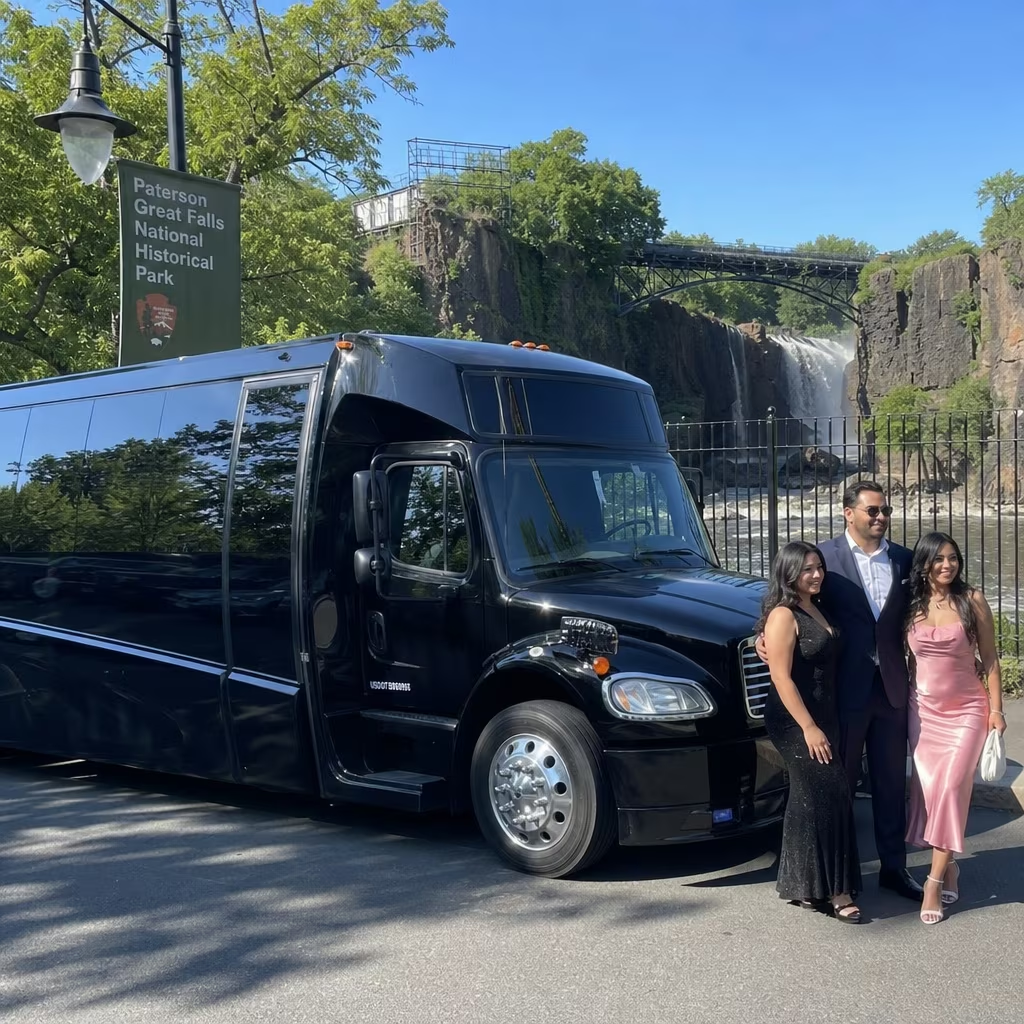
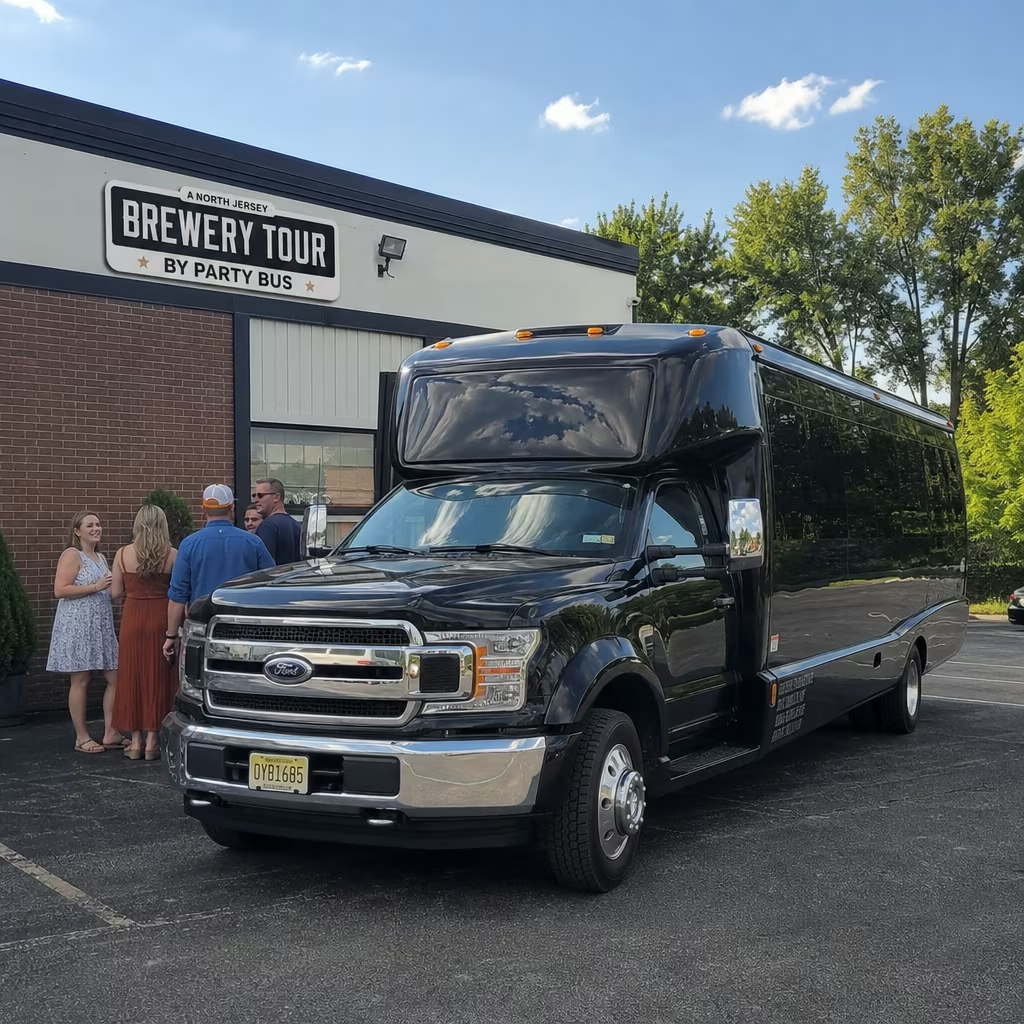
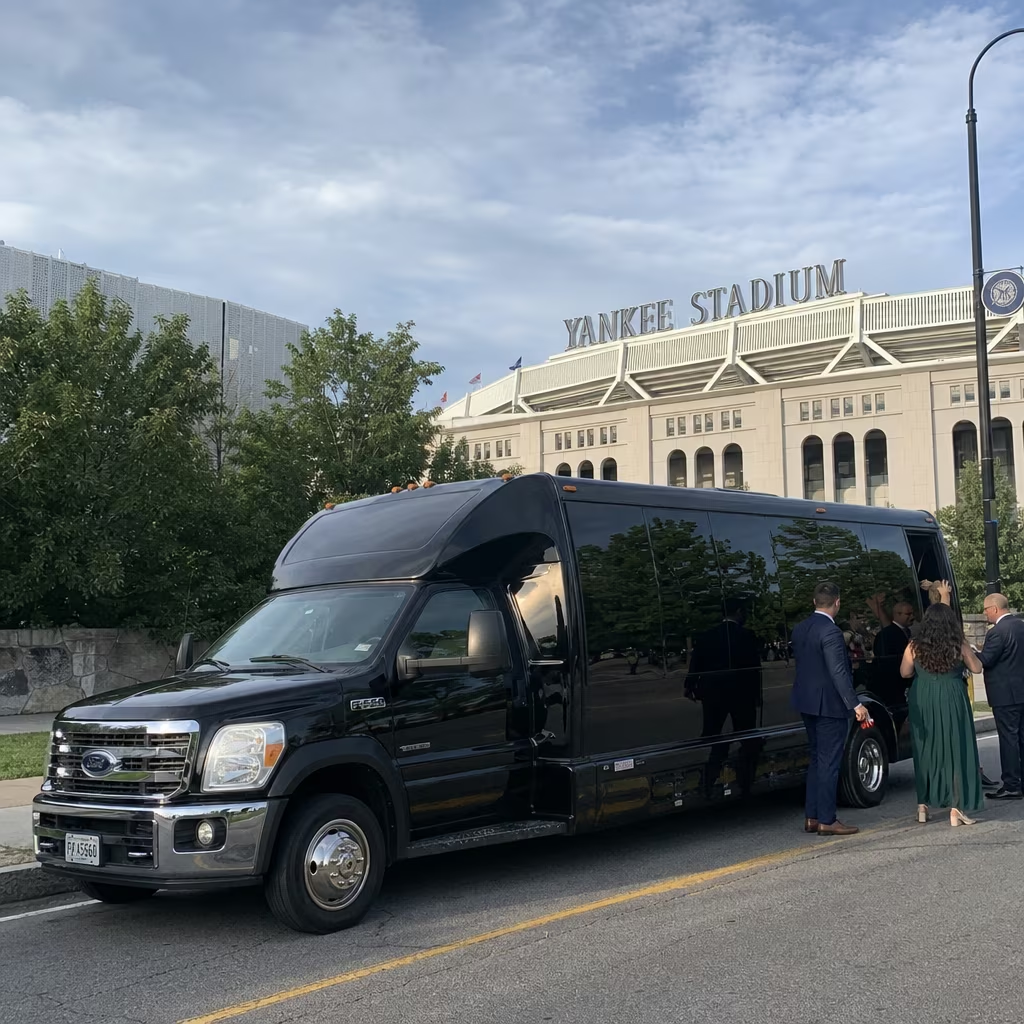
Fort Lee Historic Park sits on 33 acres of cliff-top Palisades real estate with the George Washington Bridge literally overhead, a reconstructed Revolutionary War encampment at your feet, and unobstructed views of Upper Manhattan and the Hudson River spread out below. It is one of the most convenient group sightseeing stops in the entire New York metro area — and one of the most overlooked. The single question that decides whether your group actually enjoys it is a simple one: how do you get everyone there, parked, and exploring together without the Route 4/I-95 merge eating the first hour of your day?
This guide answers it plainly. We cover the park's layout, visitor logistics, the George Washington Bridge pedestrian walk, the $20-per-bus parking setup, what a realistic half-day group itinerary looks like, and how a charter bus or minibus rental from Fort Lee turns an afternoon of Revolutionary War history into a smooth outing instead of a parking nightmare on Hudson Terrace. Party Bus Fort Lee runs group sightseeing trips to Fort Lee Historic Park regularly — so the advice below comes from planning these trips, not from a travel brochure.
Park address
2400 Hudson Terrace, Fort Lee, NJ 07024
Park size
33 acres on the Palisades cliffs
Visitor Center hours
Wed–Sun, 10 AM–4:45 PM
Bus parking
$20 flat rate per bus — metered lot on Hudson Terrace
Park phone
201-461-1776
The GWB walk
North Walk open daily 6 AM–11:59 PM — free pedestrian access
What Fort Lee Historic Park Actually Is — and Why Groups Should Know
Fort Lee Historic Park is part of the Palisades Interstate Park system, managed by the Palisades Interstate Park Commission. The site sits immediately south of the George Washington Bridge's New Jersey landing on Hudson Terrace — close enough that the bridge's lower level runs nearly overhead. In 1776, this was the site of Fort Constitution, fortified by Continental Army troops to oppose British warships moving up the Hudson River.
The British and Hessian assault on November 19, 1776 forced Washington's famous retreat across New Jersey. The park preserves that story on the actual ground where it happened.
What groups get today: a two-floor Visitor Center with exhibits reconstructing the New York Campaign (including a lighted three-dimensional terrain map that traces troop movements), a 150-seat auditorium, reconstructed 18th-century soldiers' huts and officers' quarters, restored gun batteries with firing steps overlooking the Hudson, a gift shop, and cliff-edge overlooks with clear sight lines to Upper Manhattan, the George Washington Bridge, and the Hudson River valley. The northern overlooks give you the kind of view people drive to Fort Lee specifically for — and once you add the bridge walk just steps away, the stop earns a full half-day easily.
The George Washington Bridge Pedestrian Walk — How It Works for a Group
The George Washington Bridge's pedestrian access is one of the genuinely underused group experiences in the New York metro area. The North Walk — a newly reconstructed pedestrian and cyclist path on the upper level's north side, opened in 2023 following a major upgrade — is open daily from 6:00 AM to 11:59 PM, free of charge, per the Port Authority's official pedestrian access page. No ticket, no reservation, no barrier other than the hours.
The New Jersey approach connects directly to the Long Path trail in Palisades Interstate Park and to a viewing belvedere with historical signage just off the bridge ramp. For a group that starts at Fort Lee Historic Park, the sequence writes itself: park on Hudson Terrace, spend the morning at the Visitor Center and encampment, walk north along the cliff path to the bridge's NJ approach, cross part or all of the span for the Hudson and Manhattan views, and return. The whole loop from park to bridge and back runs well under two miles.
For school groups and history tours, that combination — a reconstructed 1776 battlefield and the modern engineering achievement crossing the same river the Continental Army fought to control — covers a lot of ground in a compact area.
One practical note for large groups: the North Walk is a shared path with cyclists, and it narrows at certain points near the towers. Groups larger than 20 should move in sub-groups rather than a single column, and agree on a turn-around or meeting point before the walk begins. The bridge span stretches 4,760 feet (about 0.9 miles) one way, so a full crossing and return is a 1.8-mile walk from the NJ ramp.
Most group visits do a partial crossing to the first tower viewing area and turn back — plenty of view for the photo stop.
Fort Lee Historic Park Visitor Logistics: What Your Group Needs to Know
The Visitor Center is open Wednesday through Sunday, 10:00 AM to 4:45 PM, and closed on most holidays (exceptions: Memorial Day, Independence Day, and Labor Day). The park grounds are open daily from sunrise to sunset, so even on a Monday you can access the overlooks and encampment — the exhibits and auditorium are the piece that requires Wednesday-through-Sunday scheduling. Plan the Visitor Center as the main event of a Wednesday-through-Sunday group trip; if your date falls on a weekday, the grounds-only visit still delivers the views and reconstructed encampment.
Metered parking on Hudson Terrace is in effect year-round. The flat bus parking rate is $20 per bus — the same rate that applies across Palisades Interstate Park Commission sites for groups arriving by bus. Car parking runs $1.50 per hour on weekdays and $2.50 per hour on weekends, payable by credit/debit card at pay stations or via the Park Mobile and Flowbird apps (no cash accepted).
The lot is metered, not gated, so a bus drops and parks without the ticketing friction you encounter at a toll-booth entry. That said, the lot is not large — on busy summer weekends, Hudson Terrace fills before 11 AM. Arriving by bus with one vehicle in one space, rather than 10 cars in 10 spaces, is a real practical advantage here.
Groups planning the living history school program should know it runs September through November and March through June, serves grades 5 and up, runs 4.5 hours with hands-on participation, and is priced at $8 per participant. Reservations are required — contact the park at 201-461-1776 or flhp@njpalisades.org well ahead of your preferred date. The program fills up quickly in spring when New Jersey schools concentrate their field trip calendars.
We recommend booking the program and the bus in the same call so the timing is locked down together.
The one-line version for groups: bus parking at Fort Lee Historic Park is a flat $20, the Visitor Center runs Wednesday through Sunday, and the living history program for grades 5+ costs $8 per student with advance reservations required. These three facts, sourced directly from the park, are what keep a 40-person group from showing up on a Tuesday and finding the exhibits closed — or discovering the spring program slots are full in April when they call in March.
The Traffic Reality Around Fort Lee — Why It Matters for Your Group
Fort Lee sits at one of the most reliably congested intersections in the United States. The I-95 and Route 4 interchange in Fort Lee has been identified by the American Transportation Research Institute as the #1 traffic bottleneck in the country, and the George Washington Bridge carries more than 287,000 vehicles on an average day — making it the world's busiest motor vehicle bridge. During GWB backups, traffic diverts onto Lemoine Avenue and Bridge Plaza, turning Fort Lee's local streets into an extension of the highway gridlock.
On a Friday afternoon or a summer weekend morning, finding a parking spot on Hudson Terrace in a private car can take as long as the rest of the trip.
For a group arriving in 12 separate cars, that means 12 rounds of Hudson Terrace parking stress, 12 credit card transactions at the meter, and the near-certainty that some portion of your group will end up circling while others are already at the overlook. One bus handles all of it: a single $20 parking transaction, one vehicle, and everyone at the cliff-top together from the moment you arrive. The route over from Fort Lee's residential neighborhoods or from the broader Bergen County area avoids the bridge approach entirely — which is the specific friction that rideshare pickups and self-driving visitors on Route 4 cannot escape.
Your group skips the approach-road crawl that everyone else is stuck in.
What a Half-Day Group Itinerary Actually Looks Like
Fort Lee Historic Park works best as the anchor of a three-to-four hour morning or afternoon, with room to extend into the surrounding area if your group wants more. Here is the timeline most groups use:
- Arrival (10:00 AM on a Visitor Center day): Bus drops at the Hudson Terrace lot. Group enters through the Visitor Center, starts with the two-floor exhibit galleries and the three-dimensional New York Campaign terrain map. Budget 45 minutes to an hour for a self-guided walk-through; the auditorium presentation adds 20 minutes if you book it.
- Encampment walk (11:00 AM–11:45 AM): Move through the reconstructed soldiers' huts, the officers' quarters, the blockhouse, and the gun batteries with firing steps overlooking the Hudson. The overlooks here — especially the northern battery — are the best angle for the GWB photograph. Clear days in the fall and spring give you Manhattan from the Palisades edge with nothing between you and the skyline.
- GWB North Walk (11:45 AM–12:30 PM): Walk north along the cliff path from the park to the bridge's NJ approach. Cross to the first tower viewing area for the Hudson River panorama and return. For a group of 30, allow 45 minutes for the out-and-back to the viewing platform.
- Lunch and next stop (12:30 PM onward): The bus is right there on Hudson Terrace. From here, groups branch in a few directions: Edgewater's waterfront strip along River Road for Hudson River dining, the Korean restaurant corridor along Lemoine Avenue and Main Street in Fort Lee, or the Palisades Center or River Road shops heading south toward Edgewater.
The living history program for school groups runs longer at 4.5 hours and replaces the self-guided walk entirely — it includes cooking demonstrations, uniform and equipment handling, and period discussions that turn the whole visit into an immersive classroom. School groups using that format should build the day around the program only, with the bus waiting nearby during the session and a clear pickup time arranged before the group goes inside.
Getting to Fort Lee Historic Park: Every Group Option Compared
The park is on Hudson Terrace in Fort Lee. Getting a group there is straightforward in concept and genuinely complicated in execution, depending on how you do it.
| Option | Arrive together? | Parking cost | GWB traffic exposure | Best group size |
|---|---|---|---|---|
| Private charter bus or minibus | Yes — one vehicle | $20 flat per bus | Route avoids the bridge approach | 15–56 |
| Multiple private cars | No — split across cars | $1.50–$2.50/hr per car | Full exposure — lot fills fast on weekends | 1–4 per car |
| NJ Transit bus (Routes 158, 166, others) | Only if on the same bus | Fare only | Subject to bridge traffic delays | Any, but no group control |
| Rideshare (Uber/Lyft) | No — multiple cars, staggered | Per-car each way — surge likely on weekends | Full exposure | 1–4 per car |
The honest framing: for a solo traveler or a couple, the NJ Transit bus over the GWB is a genuinely practical option — Routes 158, 166, and the Trans-Bridge Lines run across the bridge into Manhattan regularly, and the reverse trip from the Port Authority Bus Terminal puts you in Fort Lee without a car. For anything larger than a handful of people traveling together on a schedule, one bus is the cleaner answer by every measure. It parks cheaper than two cars on a weekend, it doesn't split the group up, and it is the only option that picks everyone up at one door when you are ready to leave — not when a surge-priced rideshare finally arrives after the Saturday afternoon rush.
What Size Vehicle Does Your Group Need?
Fort Lee Historic Park is a moderate-duration stop, not an all-day stadium event — so matching the right vehicle is straightforward. Most sightseeing groups here are in the 15-to-40-person range, which puts you squarely in minibus and mid-size party bus territory.
| Vehicle | Typical seats | Luggage/gear | Best for | Key amenities |
|---|---|---|---|---|
| Sprinter van / 14-passenger Sprinter limo | Up to ~14 | Modest — day bags, camera gear | Small family groups, corporate team sightseeing | Premium leather, USB charging, tinted windows |
| 15–35 passenger minibus | ~15–35 | Overhead plus underfloor | School groups (smaller classes), church groups, adult tours | Powerful A/C, plush reclining seats, overhead storage |
| Party bus (15–50 passengers) | ~15–50 | Onboard, lighter | Celebration groups combining the park with an evening out | Built-in bar, LED lighting, Bluetooth sound, flat-panel TVs |
| 40–56 passenger charter bus | Up to 56 | Excellent — undercarriage bays | Full school classes, large church groups, senior tours | Reclining seats, climate control, WiFi, power outlets, onboard restroom, undercarriage storage |
For a school field trip combining the living history program with the GWB walk, the full-size charter bus is the right call — an onboard restroom means no mid-trip scramble to the Visitor Center facilities during the program, and the undercarriage bays carry lunch coolers and backpacks without the group hauling everything through the encampment. For a smaller adult sightseeing group spending the morning at the park and the afternoon at an Edgewater waterfront lunch, a 15-to-25 passenger minibus keeps it right-sized and leaves you flexibility for a second stop without paying for seats you do not need. ADA-accessible vehicles are available — let Party Bus Fort Lee know your group's needs when you book.
Extending the Day: What to Add After Fort Lee Historic Park
Fort Lee Historic Park is compact enough to finish in a morning, which makes it easy to combine with one or two more stops in the same area. A few combinations groups do regularly:
- Edgewater waterfront lunch. River Road from Fort Lee south into Edgewater runs along the Hudson with Manhattan views the entire way. HAVEN Riverfront Restaurant & Bar in Edgewater sits directly on the water with a clear Manhattan skyline backdrop — a logical next stop after a morning of colonial history. NY Waterway ferries from Edgewater Landing connect to Battery Park City and West Midtown for groups that want to continue into Manhattan.
- Korean dining in Fort Lee. Fort Lee's Lemoine Avenue and Main Street corridor is one of the densest Korean restaurant concentrations in New Jersey. Groups that want to eat locally after the park have no shortage of options. Gammeeok (Fort Lee location) offers 24-hour seolleongtang in a setting that handles large parties; the surrounding blocks have Korean barbecue, pub-style pojangmacha dining, and bakeries that fill out a two-hour lunch without anyone leaving Fort Lee.
- Palisades Center Mall (West Nyack, NY). For groups that want to add a shopping stop, the bus can run north on Route 9W across the New York state line into Rockland County. It is about 25 minutes from Fort Lee with light traffic.
- Yankee Stadium via the GWB. For groups combining a history stop with an evening game, the park in the morning and Yankee Stadium at night over the GWB is a one-bus itinerary that works. Cross at the upper level, park in the Yankee Stadium bus lot on Ruppert Place, and let everyone spend the afternoon in the Bronx before the first pitch.
School Groups & the Living History Program: The Logistics
The living history program at Fort Lee Historic Park is the park's most in-depth offering and the one that most frequently brings school groups out. Here is what to know before you reserve:
- Grade eligibility: Grade 5 and up, specifically for classes studying the American Revolution.
- Duration: 4.5 hours, combining discussion, demonstration, and hands-on participation. The program is immersive enough that it is the whole day's activity — not a quick tour.
- Cost: $8 per participant. Schools supply materials for activities including cooking lunch during the program.
- Season: September through November and March through June. Summer and winter are not program months.
- New Jersey schools only: School and camp field trip permits are issued for New Jersey-based institutions only. Out-of-state schools should contact the New York section of the Palisades Interstate Park at 845-271-5743.
- Advance reservation required: Contact the park at 201-461-1776 or flhp@njpalisades.org. Spring slots — April and May, when American Revolution curriculum peaks — fill up weeks ahead. If your school targets April, reserve in February.
For schools traveling by bus under a group or field trip permit, the Palisades Interstate Park issues a bus placard with the permit, and that placard covers Parkway travel without a separate transponder — useful if your route includes the Palisades Interstate Parkway from your school to the park. Call Party Bus Fort Lee at 551-415-2460 alongside the park reservation to lock in the right vehicle and pickup plan for the 4.5-hour program window. The bus parks on Hudson Terrace, the group walks in, and a clear pickup time ensures no one is standing around waiting when the program wraps at 2:30 or 3:00 PM.
Spring booking urgency: April and May are the hardest months to get both a program reservation at the park and a bus in the same window. Schools that call Party Bus Fort Lee in February for April field trips lock in the bus and the living history slot together. Schools that call in late March for April trips often find program slots taken — and bus availability thin from prom season overlapping the same calendar.
Book both in one call, early.
Getting There: Routes and Approach for a Bus Group
Fort Lee Historic Park's entrance is on Hudson Terrace, immediately south of the GWB's NJ landing. Getting there without fighting the I-95 and Route 4 interchange is the specific logistical puzzle that every group from this area faces.
| Coming from… | Recommended approach | Typical drive time (off-peak) |
|---|---|---|
| Fort Lee residential / Bergen County south | Lemoine Ave or Main Street to Hudson Terrace north | 5–15 minutes |
| North Bergen / Secaucus via NJ Turnpike | NJ-3 East to Route 1&9 to Lemoine Ave — avoids I-95 core | 20–30 minutes |
| Passaic / Clifton via Route 3 | Route 3 East to I-95 North, exit Route 4 East, right to Hudson Terrace | 25–35 minutes |
| Union City / Weehawken via Bergenline Ave | North on Bergenline to Palisade Ave to Hudson Terrace | 15–25 minutes |
| Paterson / Route 46 corridor | Route 46 East to I-95 South, exit Route 4 East | 30–40 minutes |
The core advice: avoid the I-95 core interchange from the south during any morning from 7 AM to 10 AM, and avoid it from the north during any evening from 4 PM to 7 PM. The approach from Lemoine Avenue in Fort Lee's residential core — north to Hudson Terrace — skips the interchange entirely and puts you at the park in minutes. That local routing is what makes a bus from Party Bus Fort Lee different from a caravan of out-of-county visitors following their GPS straight into the bottleneck.
Tips for Visiting Fort Lee Historic Park with a Group
A few things every group organizer should know before arriving, drawn from the park's own published guidance:
- Visitor Center is Wednesday through Sunday only. Confirm your visit day before you finalize. A Monday or Tuesday visit accesses the grounds and overlooks but not the exhibits, auditorium, or gift shop.
- No cash at parking meters. The Palisades Interstate Park Commission accepts credit/debit only at pay stations, plus the ParkMobile and Flowbird apps. Have a card ready or download the app before arrival — the lot has no cash option and no attendant to help.
- Bus parking is $20 flat. Confirm with the park when you reserve the living history program, as permit coordination may adjust the staging.
- The GWB North Walk has a curfew. It closes at 11:59 PM daily. For groups planning an evening visit or a sunset walk, confirm the season-adjusted closure time with the Port Authority's pedestrian access page before your trip — bridge access policy has shifted in the past.
- The encampment is outdoors. Dress for the season. The Palisades cliff edge is consistently 5–10 degrees cooler than inland Bergen County, and wind off the Hudson can be significant in spring and fall. Comfortable walking shoes are mandatory — the battery areas involve uneven terrain.
- Check the official page before any visit. We highly recommend reviewing the Palisades Interstate Park Fort Lee page before your visit for current hours, any temporary closures during construction or maintenance, and living history program availability.
Frequently Asked Questions
Where exactly does a bus park at Fort Lee Historic Park?
Buses park in the metered lot on Hudson Terrace directly at the park entrance — at a flat rate of $20 per bus. The lot is at the intersection of Hudson Terrace and Center Avenue, immediately south of the GWB. It is smaller than it looks on a map, so a single bus taking one spot (versus a group arriving in 10 private cars) is a meaningful practical advantage, especially on weekends when the lot fills before 11 AM.
Can a school bus or charter bus do the Palisades Interstate Parkway to reach the park?
Groups traveling under a group use permit or field trip permit issued by the Palisades Interstate Park Commission receive a bus placard with that permit that covers Parkway travel — no separate transponder needed. For a group not under a permit, confirm Parkway access with the park before routing that way. The simplest approach from most Fort Lee and Bergen County origins avoids the Parkway entirely and uses Lemoine Avenue and Main Street into Hudson Terrace.
What are the Visitor Center hours at Fort Lee Historic Park?
Wednesday through Sunday, 10:00 AM to 4:45 PM. Closed most holidays, open Memorial Day, Independence Day, and Labor Day. The park grounds — including the encampment, gun batteries, and overlooks — are open daily from sunrise to sunset regardless of Visitor Center hours.
How long should a group plan to spend at Fort Lee Historic Park?
A self-guided visit covering the Visitor Center exhibits and the outdoor encampment and overlooks runs 90 minutes to two hours. Adding the George Washington Bridge North Walk out to the first tower viewing area and back adds another 45 minutes to an hour. The living history school program is a full 4.5 hours on its own.
Budget two to three hours for a general group sightseeing visit, more for a school program or a bridge walk.
Can the bus wait for us at the park while we visit?
Yes. The bus is booked as a block of hours, so it parks on Hudson Terrace for the duration of your visit and is ready and waiting when your group finishes. Arrange a clear pickup time with our team before your group enters the park, so there is no confusion when you come back out.
That is especially important for the living history program, where the 4.5-hour window is firm.
How far in advance should a school group book for the spring program?
Contact the park in February for an April or May visit. The spring living history program window (March through June) is the peak booking period for New Jersey schools, and the 4.5-hour format means only a limited number of groups can be scheduled per week. Book the park program and the bus in the same call so both are confirmed together.
Calling in March for April usually works for the bus but often finds program slots already taken. Call 551-415-2460 to get started.
How much does a Fort Lee charter bus rental cost?
Pricing depends on your group size, vehicle type, total hours, and your pickup location. As a guide: 15–35 passenger minibuses run $150–$275 per hour; party buses in the 25–50 passenger range run $200–$450 per hour; and full-size 40–56 passenger charter buses run $150–$300 per hour. A typical half-day sightseeing trip to Fort Lee Historic Park — three to four hours including transit, the visit, and a lunch stop in Edgewater — comes out to a flat rate that splits well across 20 or more riders.
Call 551-415-2460 for an all-inclusive quote with no hidden costs.
Is the George Washington Bridge walk free?
Yes. The North Walk on the upper level is free of charge for pedestrians and cyclists, open daily from 6:00 AM to 11:59 PM. No ticket, no reservation required.
Access from the New Jersey side connects directly to the Long Path trail at the park boundary. Confirm the current hours at the Port Authority's pedestrian access page before your visit.
Book Your Group Visit to Fort Lee Historic Park Today
A Fort Lee Historic Park visit hits differently when the logistics are handled. No one draws straws for who drives, no one is circling Hudson Terrace for a parking spot, and the whole group is standing at the Palisades cliff edge looking at the George Washington Bridge at the same time. Party Bus Fort Lee runs group sightseeing trips to the park for school field trips, church groups, adult historical tours, family reunions, and corporate team outings from Fort Lee, North Bergen, Union City, Passaic, Paterson, and Clifton. The right vehicle for your headcount, a flat $20 bus parking spot, and a clear pickup plan — that is the whole trip handled.
Call 551-415-2460 for an all-inclusive price quote any time, or use our online tool for instant availability.
Sources & Last Verified
Visitor hours, parking rates, program details, and bridge access information change by season. Details verified against park and Port Authority sources in June 2026; confirm current figures before your visit.
- Palisades Interstate Park — Fort Lee Historic Park (hours, address, programs, contact)
- Palisades Interstate Park — Parking Fees (current metered and bus rates)
- Port Authority — George Washington Bridge Pedestrian & Bicycle Information (North Walk hours and access)
- Palisades Parks Conservancy — Fort Lee (program and site overview)